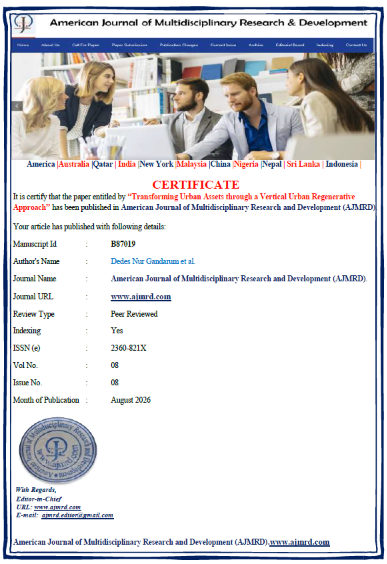
Rapid urban growth has increased pressure on the quality of urban environments, particularly in areas with historical significance and strategic urban functions. This research explores how a regenerative design approach can be integrated with vertical urban development to guide the transformation of underutilized urban assets into mixed-use environments that are more adaptive and sustainable. The study employs a literature review and a comparative analysis of twenty international precedent projects. The findings were synthesized into four main design aspects: Ecological, Resource & Efficiency, Mixed-use & Living System, and Mobility & Social Collaboration; which were further translated into eight design indicators: biodiversity enhancement, vertical greening, closed-loop resource systems, energy and water efficiency, mixed-use integration, adaptive living systems, walkability and accessibility, and community participation. These criteria were then applied to evaluate the proposed transformation of the Perum Peruri site into a mixed-use development. The results indicate that the Vertical Urban Regenerative approach provides practical design criteria for guiding urban asset transformation by integrating ecological restoration, resource efficiency, functional adaptability, and socially responsive mobility within a single development framework.
Oleh :
M. Dedes Nur Gandarum W.